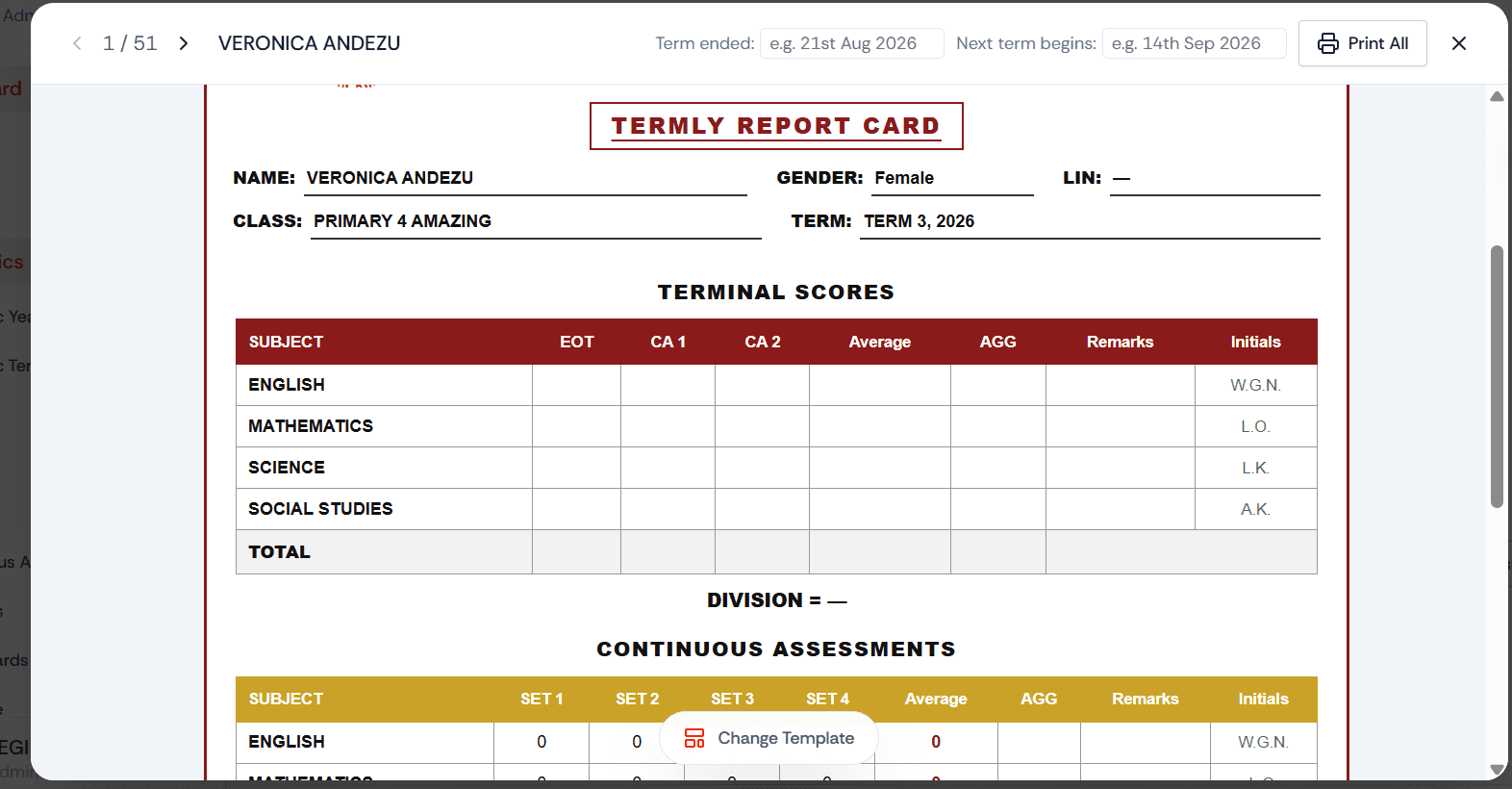
Ask any Director of Studies what the worst week of the term looks like and you will hear the same answer: report card week. Marks arrive on scraps of paper, positions are worked out by hand, comments are copied between templates, and a single transposed digit can send a card back to the start.
Where the time actually goes
The slow part is rarely the printing. It is the compilation — gathering marks from every teacher, computing averages and positions, applying the correct grading scale, and formatting hundreds of individual cards consistently.
- Chasing teachers for outstanding marks.
- Re-keying marks from paper into a master sheet.
- Calculating totals, averages, grades and class positions by hand.
- Fixing the errors those manual steps inevitably introduce.
Automating the compilation
Because Skolastik already holds every mark the moment a teacher enters it, the report card is simply a view of data that already exists. Totals, averages, grades and positions are computed automatically against your school's own grading configuration.
- Marks approval ensures only reviewed, locked marks appear on a card.
- Grading scales are applied the same way for every subject and class.
- Positions and averages are calculated instantly, not by hand.
- Cards are generated in bulk and printed or shared in one run.
Accuracy you can defend
Automation does not just save time — it removes the category of error that erodes parents' trust. When a parent questions a grade, you can trace it straight back to the marks the teacher entered, with no mystery arithmetic in between.
The payoff
Schools that move report card compilation into Skolastik routinely report the same thing: a process that once ate three days now takes an afternoon, and results reach parents while they still matter.